PDF Ebook RSS for Educators: Blogs, Newsfeeds, Podcasts, and Wikis in the Classroom, by John G. Hendron
Why should assume a lot more? Reviewing a publication will not invest or waste your time, will you? You can actually establish your time to manage when as well as where you could take pleasure in reading this publication. Also you still have the various other tasks or books to read, you can also make inter-spaced to attempt analysis this book. It will truly enrich your mind and also idea. So, if there is a better book to review, why don't try it? Let enhance your idea as well as experience of checking out several books from the broads.
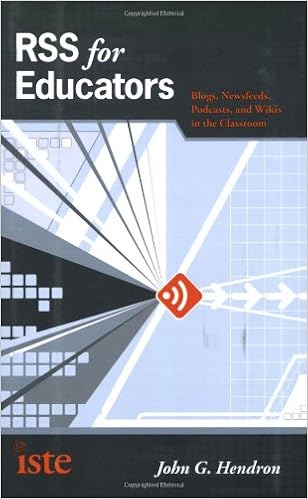
RSS for Educators: Blogs, Newsfeeds, Podcasts, and Wikis in the Classroom, by John G. Hendron

PDF Ebook RSS for Educators: Blogs, Newsfeeds, Podcasts, and Wikis in the Classroom, by John G. Hendron
Do you require brand-new recommendation to accompany your spare time when being at home? Checking out a publication can be a great selection. It can save your time usefully. Besides, by checking out publication, you could enhance your expertise as well as experience. It is not only the science or social knowledge; several points can be gotten after checking out a publication.
Do you still have no suggestion with this book? Why should RSS For Educators: Blogs, Newsfeeds, Podcasts, And Wikis In The Classroom, By John G. Hendron that comes to be the inspiration? Everybody has various issue in the life. But, related to the accurate educational as well as understanding, they will have exact same conclusions, naturally based on truths and research. And currently, exactly how the RSS For Educators: Blogs, Newsfeeds, Podcasts, And Wikis In The Classroom, By John G. Hendron will deliver the discussion about exactly what truths to always be mind will certainly influent exactly how some individuals think and also bear in mind about that issue.
When someone aims to read the RSS For Educators: Blogs, Newsfeeds, Podcasts, And Wikis In The Classroom, By John G. Hendron, it will imply that they has started something brand-new, the new wisdom. So, you require likewise to be one of them that could obtain all generosity of reading this publication. As recognized, analysis is considered as one need to do be everybody. If you think that reading must be done only by the pupils, that's definitely incorrect. You might face the life fell short.
Concerning this publication, you may not have to be stressed to obtain it as reviewing product. This book shows how you can begin to enjoy analysis. This publication will certainly show you exactly how modernity will certainly complete the life. It will certainly also confirm that entertaining publication will certainly be likewise valid book that depend upon just how the author informs and utter the significance to the visitors. Based upon this situation, now you have to choose RSS For Educators: Blogs, Newsfeeds, Podcasts, And Wikis In The Classroom, By John G. Hendron as one of your collections to review. One more time, that's for your reading product.
About the Author
John G. Hendron has been employed since 1999 as a teacher and instructional technologist for Goochland County Public Schools in Virginia. Hendron produces a regular podcast for members of the Virginia Society for Technology in Education (VSTE). He also freelances as a graphic and Web designer. In December, 2006, he received the Virginia State Technology Leadership Award from the Virginia Department of Education.
Read more
Product details
Paperback: 120 pages
Publisher: International Society for Technology in Education (March 15, 2008)
Language: English
ISBN-10: 1564842398
ISBN-13: 978-1564842398
Product Dimensions:
5.5 x 0.8 x 8.5 inches
Shipping Weight: 15.2 ounces (View shipping rates and policies)
Average Customer Review:
4.5 out of 5 stars
9 customer reviews
Amazon Best Sellers Rank:
#4,058,216 in Books (See Top 100 in Books)
Reviewed by: Michelle MillmanJohn G, Hendron’s book, “RSS for Educators†is a great tool and resource for teachers in any grade level (K-12) to utilize in order to bring Web 2.0 tools effectively into the classroom. The book discusses different Web 2.0 tools such as blogs, podcasts, and wikis on a very user friendly and informative level. This allows for the educator to learn about these tools and the way they can be utilized in the classroom and the effect it can have on student learning in the classroom.Hendron discusses his own experiences in Gochland County, Virginia and their policy that requires all teachers to maintain a blog. His arguments presented both for and against this idea are interesting and have great implications in the educational field. At the very least, the topic of requiring teachers to keep a blog (once developed as a way for people to personally connect and share their own thoughts, ideas, and opinions) opens up discussions of the way technology has integrated itself in classrooms and school districts.The book has a lot of great up to date information that allows educators to connect to students. For example, using iTunes to subscribe to podcasts or utilizing Audacity. Hendron gives the reader a wealth of information and sites to visit in order to effectively use Web 2.0 tools and often accompanies this information with screen shots of the site so the reader can become familiar with the site and its features. His step by step directions of sites prove to be incredibly useful and gives the reader great resources.With the information that is on the Web, Hendron offers the reader ways to minimize search time of information and maximize the information available. Tagging or using sites such as del.icio.us are effective ways to find information that Hendron mentions.With a lot of great, up to date information, the older 2006 publication date sometimes does show. In Hendron’s mention of Myspace and his lack of more popular social media outlets such as Facebook, Instagram, or Twitter, the date of publication is more evident. However, Hendron shares a lot of great lesson ideas complete with grade levels, content area, standards, objectives, resources, procedures, and assessments. For an educator who is just beginning their technological journey or those who are looking to mix in different aspects of technology, these lessons are great resources.Overall, this book was a nice read. It was written with the educator in mind and how to develop some of the more popular Web 2.0 tools. This is worth a read to any educator looking to either learn a little bit more about these tools or those who want to offer their students technology experiences in the classroom as part of the curriculum.
Whatever happened to Web 1.0? Readers of John Hendron's (2008) book, RSS for Educators, will quickly realize the speed at which web technology has evolved. From its humble Web 1.0 beginnings of one-way, read-only applications on the information highway, we now have two-way, read-write RSS (Really Simple Syndication) apps and tools in a new revolutionary freeway of innovations of computer commuters networked by information using blogs, podcasts, newsfeeds, and wikis. This can be about everything, be from anywhere, happen everywhere, and on all kinds of devices (Wesch, 2008) For someone who has an older one-way computer background, John Hendron's book is an eye-opener not only for techies, but also especially for educators who must merge into the new-era of Web 2.0 information travels. The new features of this highway are succinctly defined with helpful diagrams picturing Client/Server/Local User paradigms to help us understand where we are located in this interactive information highway called the Internet. For someone who had little background on Web 2.0, this book was very readable with new technologies clearly explained. Much of the author's discussion of blogs, wikis, etc. seamlessly interact with his classroom experience as a teacher and liaison to district administrators and parents, in bringing them together to experience and benefit from the slew of technologies available to help them communicate and better education. The strength of the book is in its balance of presenting Web 2.0 technologies in a readable but also very technical fashion. Teachers can quickly make progress by using the recommended websites to start blog accounts, wikis, etc. A brief range of the most popular and powerful technologies are presented for the consumer to choose from depending on his/her situation. Whether it is blogs, wikis, podcasts, VoIP, or newsfeeds, the author usually surveys the most effective tools, always giving attention to both platforms, whether it is PC or Macintosh. His only weakness is his unhidden bias for Macs. However, the detail of his interaction with the technology is fair. His treatment of these is up-to-date and current. In relation to Wikis, John gives helpful examples of using wikis for department meetings, notes, minutes, and even curriculum development. Here is where the "Ah Haa" moments echo where he provides specific uses of wikis from his own educational experience. The technology of Web 2.0 is not confined to the classroom, but transcended by things like videoconferencing, and also usable in teacher business as well as district business. The two-way roads of technology are expanding to the many facets of education. When it comes to blogging, the author adequately surveys the popular blog resources available to begin web 2.0 applications. Again, both PC and Macintosh platforms are represented. The section does seem overly technical for educators, but as an educator with computer background, I found it very helpful. What I appreciate about Hendron's treatment is the balance of adequate technical help with the creativity of the Web 2.0 applications. Especially eye-opening were the classroom lesson plans using blogging technology to accomplish educational objectives. What administrator would not drop his/her jaw to see this kind of technology used in the classroom to engage and bring much needed collaboration to the classroom using technology? The lessons were replete with collaborative ideas using engaging technology. The only criticism is that the lesson plans did not include a single math lesson. This reviewer is a secondary math teacher. In the final analysis, the esoteric technical title of the book is actually a rich and readable ride into the revolutionary Web 2.0 technology of not the future, but the present. It's explained clearly across both platforms and surveyed across the most popular tools. This is an excellent primer on information travel for Web 2.0.
RSS for Educators: Blogs, Newsfeeds, Podcasts, and Wikis in the Classroom, by John G. Hendron PDF
RSS for Educators: Blogs, Newsfeeds, Podcasts, and Wikis in the Classroom, by John G. Hendron EPub
RSS for Educators: Blogs, Newsfeeds, Podcasts, and Wikis in the Classroom, by John G. Hendron Doc
RSS for Educators: Blogs, Newsfeeds, Podcasts, and Wikis in the Classroom, by John G. Hendron iBooks
RSS for Educators: Blogs, Newsfeeds, Podcasts, and Wikis in the Classroom, by John G. Hendron rtf
RSS for Educators: Blogs, Newsfeeds, Podcasts, and Wikis in the Classroom, by John G. Hendron Mobipocket
RSS for Educators: Blogs, Newsfeeds, Podcasts, and Wikis in the Classroom, by John G. Hendron Kindle
0 Reviews:
Posting Komentar