Ebook The Unthinkable: Who Survives When Disaster Strikes - and Why, by Amanda Ripley
For you that want this The Unthinkable: Who Survives When Disaster Strikes - And Why, By Amanda Ripley as one of your friend, this is very extraordinary to locate it. You could not need long time to find what exactly this publication gives. Getting the message straight when you are reading sentence by sentence, page by page, is kind of health. There may be only few people who can not get the messages obtained clearly from a book.
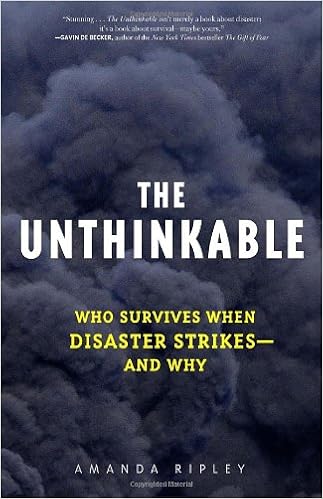
The Unthinkable: Who Survives When Disaster Strikes - and Why, by Amanda Ripley

Ebook The Unthinkable: Who Survives When Disaster Strikes - and Why, by Amanda Ripley
When you are rushed of work deadline and have no concept to obtain inspiration, The Unthinkable: Who Survives When Disaster Strikes - And Why, By Amanda Ripley book is among your remedies to take. Reserve The Unthinkable: Who Survives When Disaster Strikes - And Why, By Amanda Ripley will provide you the ideal resource as well as thing to obtain motivations. It is not only concerning the jobs for politic business, management, economics, and also various other. Some ordered works making some fiction your jobs additionally require inspirations to overcome the task. As exactly what you need, this The Unthinkable: Who Survives When Disaster Strikes - And Why, By Amanda Ripley will most likely be your option.
Naturally, from childhood to permanently, we are constantly believed to love reading. It is not only reviewing the lesson book however additionally checking out everything good is the selection of getting new inspirations. Religious beliefs, sciences, national politics, social, literary works, as well as fictions will certainly improve you for not just one element. Having even more aspects to recognize and recognize will certainly lead you become somebody much more precious. Yea, coming to be priceless can be positioned with the presentation of how your understanding a lot.
From the book, you will certainly understand that reading is absolutely should do. It will guide you to obtain more precious spending time. By checking out guides, your hung out will not throw away incorrectly. You can find just what you want and needs to observe. Here, the The Unthinkable: Who Survives When Disaster Strikes - And Why, By Amanda Ripley ends up being a selection to review the book because it gives you the amazing features of the life. Even it is only the agent are for getting this type of publication, you could see how you could delight in guide precisely.
Why should assume extra? Reviewing a publication will not spend or waste your time, will you? You can truly set your time to handle when as well as where you could appreciate reading this book. Also you still have the other tasks or publications to read, you can also make inter-spaced to try reading this publication. It will really enrich your mind and also thought. So, if there is a far better book to review, why don't try it? Let enrich your thought and experience of checking out lots of books from the broads.
From Publishers Weekly
Ripley, an award-winning writer on homeland security for Time, offers a compelling look at instinct and disaster response as she explores the psychology of fear and how it can save or destroy us. Surprisingly, she reports, mass panic is rare, and an understanding of the dynamics of crowds can help prevent a stampede, while a well-trained crew can get passengers quickly but calmly off a crashed plane. Using interviews with survivors of hotel fires, hostage situations, plane crashes and, 9/11, Ripley takes readers through the three stages of reaction to calamity: disbelief, deliberation and action. The average person slows down, spending valuable minutes to gather belongings and check in with others. The human tendency to stay in groups can make evacuation take much longer than experts estimate. Official policy based on inaccurate assumptions can also put people in danger; even after 9/11, Ripley says, the requirement for evacuation drills on office buildings is inadequate. Ripley's in-depth look at the psychology of disaster response, alongside survivors' accounts, makes for gripping reading, sure to raise debate as well as our awareness of a life-and-death issue. 8 pages of color photos. (June) Copyright © Reed Business Information, a division of Reed Elsevier Inc. All rights reserved.
Read more
Review
"A fascinating and useful new book.” —The New York Times “The thinking person’s manual for getting out alive.” —NPR "Ripley is a voyeur on a mission...Her conviction: We’d all stand a better chance of surviving a disaster if we understood what happens to our little gray cells when things get ugly....Spiced with surprising factoids, this book might save your life one day.” —Bloomberg News “The Unthinkable is part study of the science of reaction to extreme fear, part indictment of the US government’s response to the terrorist threat, part call to arms....The end result is a fascinating book....Despite its title and its subject matter, The Unthinkable is an optimistic… —The Times of London “Engrossing and lucid...An absorbing study of the psychology and physiology of panic, heroism, and trauma...Facing the truth about the human capacity for risk and disaster turns out to be a lot less scary than staying in the dark.” —O, The Oprah Magazine"This is a book with a purpose, meant to change things."—Rob Hardy, The Commercial Dispatch“Amanda Ripley takes us on a sometimes stunning, sometimes sobering journey through disaster, using great stories and respected science to show why some prevail and others do not. The Unthinkable isn’t merely a book about disaster; it’s a book about survival — maybe yours.” ——Gavin de Becker, author of the New York Times bestseller The Gift of Fear“With The Unthinkable, Amanda Ripley succeeds in two different ways. First, she covers, with great clarity and accuracy, the science of how the body and mind respond to crisis. In the process, she prescribes certain actions that will increase the chances of surviving a disaster. But it’s the second aspect, the stories, that makes the book so compelling. These tales leave your viscera enflamed because they compel two questions: ‘What would it feel like to go through that?’ and ‘Would I do the right thing and survive?’ This is an irresistible book.”—Robert M. Sapolsky, John A. and Cynthia Fry Gunn Professor of Biological Sciences and Professor of Neurology and Neurological Sciences at Stanford University“The Unthinkable is the most magnificent account of a survivor’s mind that I have ever read. It has helped me know and accept some of my reactions during my 72 day ordeal in the Andes. I can now understand how fear motivated me, and how denial also played a part. This book will help those who’ve never faced disaster to understand their own behavior and be prepared should their luck run out one day.”—Nando Parrado, New York Times bestselling author of Miracle in the Andes“The Unthinkable reveals why, under the same circumstances, some people caught up in a disaster survive and others do not. Why some are hopelessly immobilized by fear and crippled by panic, and others are filled with strength, endurance, reactions and the other intrinsic stuff of which Homeric heroes are made. How can we ensure which we will be? In her well-crafted prose, Amanda Ripley shows us all how to prepare to meet danger and increase our chances of surviving the unthinkable.” —Bruce Henderson, New York Times bestselling author of Down to the Sea and True North“When a disaster occurs we invariably learn the "what" of the event -- how many died, how many survived. Amanda Ripley’s riveting The Unthinkable provides genuine insight into the "why" behind the numbers. This remarkable book will not only change your life, it could very well save it.”—Gregg Olsen, New York Times bestselling author of The Deep Dark: Disaster and Redemption in America’s Richest Silver Mine“Ever fantasize about what you would do in a disaster? How would you survive? How would you behave? After interviewing survivors of the World Trade Center attack, Amanda Ripley sifted through amazing tales of survivors from other disasters and mined various sociological, psychological, and neurological studies. Her insights are absolutely fascinating, and they could come in handy one day.”——Walter Isaacson, author of the New York Times bestsellers Einstein: His Life and Universe and Benjamin Franklin: A Life, and Vice-Chairman of the Louisiana Recovery Authority"Rich in information about the subconscious ways we face danger. In the event that someday you face a sudden life or death situation, reading this book will increase the odds that the outcome will be life."——David Ropeik, author of Risk!: A Practical Guide for Deciding What’s Really Safe and What’s Really Dangerous in the World Around You“Reading The Unthinkable will be life-changing. We live in an age of anxiety that has too many of us rocked back on our heels. Once you’ve feasted on the rich insights and wisdom of this remarkable book, you’ll be standing tall again. While our politicians and media have been keen to exploit and fan our worst fears, Amanda Ripley makes clear that individually and collectively we can meet head-on the hazards that periodically befall us. We need not be afraid!”——Stephen Flynn, Senior Fellow for National Security Studies, Council on Foreign Relations, and author of The Edge of Disaster: Rebuilding a Resilient Nation“The Unthinkable is a fascinating, in-depth look at human behavior under extreme pressure. Its gut-wrenching stories span the full spectrum of action under duress, from panic to heroism. Not only is this book fast-paced and engrossing, it’s illuminating.” ——Michael Tougias, author of Fatal Forecast: An Icredible True Tale of Disaster and Survival at Sea“Amanda Ripley has written a smart, poignant account about the dramas of the existential moment in this new century. She is a provocative voice of a new generation of writers and thinkers whose grasp of daily events and global disaster is piquant, engrossing, and syncretic. Above all, she makes sense of life today in an entirely entertaining and accessible way-- all with a brimming dollop of optimism. If you ever wondered, ‘What would I do if the unthinkable happened to me,’ you hold the answer in your hands.”—Doug Stanton, author of the New York Times bestseller In Harm’s Way: The Sinking of the USS Indianapolis and the Extraordinary Story of Its Survivors "A must read. We need books like this to help us understand the world in which we live.”—Nassim Nicholas Taleb, author The Black Swan and Fooled By Randomness
Read more
See all Editorial Reviews
Product details
Hardcover: 288 pages
Publisher: Crown Archetype; First Edition edition (June 10, 2008)
Language: English
ISBN-10: 0307352897
ISBN-13: 978-0307352897
Product Dimensions:
6.4 x 1 x 9.6 inches
Shipping Weight: 1.4 pounds (View shipping rates and policies)
Average Customer Review:
4.6 out of 5 stars
372 customer reviews
Amazon Best Sellers Rank:
#365,662 in Books (See Top 100 in Books)
Recently this book was recommended at a risk management lecture, my company provided. I have to admit some of the one star ratings put me off a bit - then I really read the book.Yes, there are some stories that are a little disjointed, but they are the exception and require careful reading, not just "content scanning" to speed through the book.One of the most important lessons to take to heart is the author's assertion that safety people often protect us from danger - by refusing to "scare" us with the truth. All to often fear of scaring people is counterintuitive for survival.Working in the airline industry I saw several truths in the book about safety. I also saw the hard facts about survivors - they were often the rare person who listened to the safety briefing, listened to the flight attendant briefing and didn't try to save their carry-on bag, at the expense of their and others lives.As a survivor I saw many traits listed in this book that offered me reasons for my own survival. I hope others will seriously consider this a book worth reading.
Ripley investigates a range of disasters and tragedies – natural and man-made – with an eye toward her sub-titular question of who survives and why. Of course, in the process she answers the [often more interesting] converse question of who dies and why? By that I’m specifically referring to those who die while facing the same situations as survivors. i.e. Who dies having had the capacity to survive? Obviously, some people fail to survive because they face a fundamentally unsurvivable event (e.g. a plane explodes in mid-air with said person in it), but a surprising number die who could have walked to safety if they’d have managed to get moving – and some die because they play out a mental script that makes no sense contextually, e.g. trying to get a carry-on out of the overhead compartment as though one is at the gate at Heathrow Airport when in fact one is sinking into the ocean while the crashed airliner one is in is being buffeted by ocean waves.Over the course of eight chapters, an introduction, a conclusion, and ancillary material, the author presents cases involving airplane crashes, tsunami, hurricanes, police shootings, hostage situations, fires, stampedes (of humans by humans), and even touches on the psychology of tragedies of a personal [rather than mass] nature (e.g. sexual assault.) A particular emphasis is given to events that the reader will likely be familiar such as 9/11 and Hurricane Katrina, but the book also opens up the reader to events they may have scarcely heard of from the many crushing deaths in Mecca during recent Hajj pilgrimages to the Halifax harbor incident of 1917. Along the way, the reader hears from survivors, heroes, and a wide-range of experts on subjects such as gunfights, risk perception, evacuation dynamics, the physics of crowds, evolutionary psychology, and emotional resilience.After an introduction that sets the context for the book, the first chapter discusses one of the most salient features of whether ones lives or dies, delay. The case of the evacuation of the World Trade Center on September 11, 2001 is used to examine why some people loiter about while others are johnny on the spot to hit the road. The World Trade Center on 9/11 makes an interesting case because there were certainly people who died who could have survived if they’d had better knowledge or training. However, at the same time, it could have also been vastly worse if some of the people didn’t have the training they did (famously, a huge WTC tenant, Morgan Stanley, had a man in charge of emergency procedures, Rick Rescoria, whose persistent drills no doubt saved many lives [though he did not survive, himself.])Chapter two discusses risk, and the weird way in which human beings perceive and respond to uncertainty. For example, the author describes Kahneman and Tversky’s Prospect Theory, which showed that a person responds to risk much differently if there’s a possibility of losing something rather than only of making gains. (Prior to work of these two social scientists, the prevailing view was that humans were rational actors, i.e. a $100 is a $100.) Prospect theory confirmed that anxiety mattered, and people didn’t just use their clockwork frontal cortex to calculate and compare expected values. (This may seem self-evident, but it began the process of up-ending the precise and predictable rational actor model from classical economics.)Chapter three is entitled “fear†and it discusses that emotion and the various behaviors (and lack of behavior) that goes hand-in-hand with it, including: distortion of the experience of time, tunnel vision, and self-talk. (Panic and paralysis behaviors are each given their own chapter later in the book.) This chapter presented a fascinating discussion with a man who may have been involved in more shoot outs than any other police officer (the officer, no doubt, having a valuable perspective on how to respond in fearful situations.)Chapter four is about the personality traits that link to resilience and the survivor personality. There is a fascinating discussion with an undercover agent in Israel, a man who faced a number of situations in which he had to coolly make a life-or-death decision in the way that most of us only experience in Hollywood movies. It should be pointed out that while we all admire such people when they save the day, the personality traits they display aren’t necessarily ones that we find desirable in daily life. Chapter five is entitled “groupthink†and it discusses the role that social dynamics play in survival, which is often considerable. Some survivors are people who would’ve perished if left to their own devices – i.e. if a more resilient stranger hadn’t taken them by the hand or shouted in their face.The last three chapters discuss three relatively common behaviors that occur in the decisive moment of a tragedy. Chapter six discusses panic behavior. As it happens, there are some types of tragedies in which panic is almost unheard of and others in which it is nearly ubiquitous. Personality does play a role. Just as some people have personality traits that make them more resilient, others have traits that make them more likely to panic. However, researchers also found that there are characteristics – e.g. people feeling trapped but as if there’s a glimmer of hope of escape. [People who know they are unequivocally doomed are often surprisingly calm.] The chapter also offers some useful insights into how crowds kill people that may be useful for those who find themselves in massive crowds like those seen during pilgrimages or at any number of festivals in India (where human stampede deaths are disturbingly common.)Chapter seven is about “paralysis†behavior. Readers may be familiar that there’s been a tendency of experts to add either one or two new “F’s†to the phrase “fight or flight†– such as “freeze†or “fright†– to describe other extremely common responses to severe sympathetic nervous system engagement. It’s common to dismiss such behavior as that of cowardly or milquetoast people, but the reality is more complex. On the evolutionary timescale, there was one tragedy that counted for an overwhelming percentage of such dire events -- being in the jaws of an apex predator. It turns out that if a grizzly bear or lioness is atop you, freezing isn’t a bad strategy. You aren’t going to pop up and out run a tiger or defeat it in unarmed combat, your only hope may be to make it think you are a diseased carcass – i.e. shit yourself and lie limply. One has to train alternative behaviors; otherwise, the body does what is evolutionarily programmed into its genetic code.The last chapter is on heroic acts and why some people engage in them when most people don’t. (Consider the people in the Titanic lifeboats who listened to people struggle and drown for fear that their [almost empty] boat would be swamped with clawing victims. Or, the case of Catherine Genovese who was screaming bloody murder for half-an-hour while being raped and stabbed to death while none of the 40-ish witnesses so much as called the cops.) As with the question of what makes a survivor, the answer to what makes a hero is a mixed bag. While we tend to idolize people who engage in heroic actions, the evidence suggests that the image of pure beneficence – lacking all self-interest – may be mythical. Many a hero is as much responding with a combination of subconscious mind and genetic programming as is the individual who burns to death 100 feet from an unlocked exit – just to vastly greater adoration.I found this book to be fascinating. There are many books on this topic, but I think the author did an excellent job of choosing cases and experts to produce an interesting and informative read -- even for a reader for whom this literature is not new.
If you read only one book this year or this decade it needs to be this book!! This book offers the magic keys on surviving disasters, responding to disasters or even facing challenging problems of life. The book needs to be required reading for all employees of FEMA and every county, city, state emergency manager. Her information will cause people to view the issue of emergency response radically different than whatever view you had before you read the book.The author, Amanda Ripley has uncovered a new way to look at emergencies. She says there are several phases to response. Phase one is denial. People will deny an emergency is occurring no matter the evidence. The flames could be setting their hair on fire but they will be in denial. She cites several eye witnesses in various emergencies to support her point. One example is how people in the world trade towers took an average of 6 months to evacuate. The Hollywood Supper Club in OH had reports of people just sitting there as flames swallowed whole walls. Then the next phase deliberation. The making of a plan to do something. The last phase she calls the decisive moment. That is when people jump up and do things like pulling people out of the fire or from plane wrecks in ice clogged rivers. Her analysis and stories of these events is a real eye opener.Her conclusions offer hope. Thread through her stories are ways to win or survive the next disaster. One story that struck me is how the Kansas City Fire Department trains fire fighters to swear at people to shock them out of the denial phase. Another story is how Rick Rescorla of Morgan Stanley consistently trained the Morgan Stanley on emergency response. They were the major tenant in the world trade towers. His dedication to training put the idea in their minds to such a degree it became muscle memory. When the hijackers in 9/11 struck the towers the staff just reacted. That training led to over 98% of the Morgan Stanley staff getting out safely.
The Unthinkable: Who Survives When Disaster Strikes - and Why, by Amanda Ripley PDF
The Unthinkable: Who Survives When Disaster Strikes - and Why, by Amanda Ripley EPub
The Unthinkable: Who Survives When Disaster Strikes - and Why, by Amanda Ripley Doc
The Unthinkable: Who Survives When Disaster Strikes - and Why, by Amanda Ripley iBooks
The Unthinkable: Who Survives When Disaster Strikes - and Why, by Amanda Ripley rtf
The Unthinkable: Who Survives When Disaster Strikes - and Why, by Amanda Ripley Mobipocket
The Unthinkable: Who Survives When Disaster Strikes - and Why, by Amanda Ripley Kindle
0 Reviews:
Posting Komentar